NCEA Level 1, TEG Exam 2018
overview | comments regarding questions | conclusions
Overview
The NCEA Level 1 Mathematics – Tables, Equations, Graphs (TEG) 2018 exam held on Tuesday 20 November 2018 has one of the most incredibly poorly worded questions I've ever seen in an NCEA exam, and after the fiasco in 2016 that's saying something. Writing this later, it seems incredible that this wasn't screamed about at the time.
I'll repeat what I said about the 2016 MCAT exam.
Question: Was the exam really "thoroughly checked"? Clearly, obviously, blatently NO.
Comments regarding questions
QUESTION TWO
(b) (i).
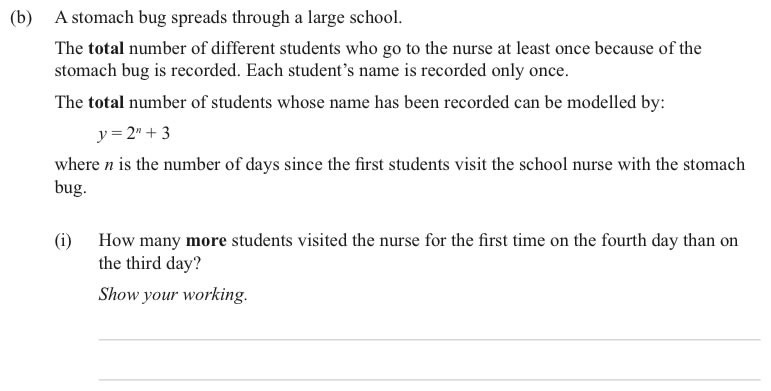
Most examinees apparently interpreted the question as meaning something like "How many new sick students were first recorded on the fourth day?" But ask yourself this: Why wasn't that the question asked?
That question is simpler, and clearer. Is the actual question deliberately confusing?
We've been told that students are only recorded once, when they first visit the school nurse, and that the equation gives "The total [in bold!] number of students whose name has been recorded". Thus, any increase in the total number of students for day 4 will be new students, visiting for the first time because their names are being recorded for the first time.
But that simplified question is not the question asked. Ask yourself why the word more in the question is in bold.
What was there more of on the fourth day than on the third day? More total sick students, or more new sick students? What are we being actually asked?
Answering the simplified version of the question:
`n=4: y = 2^4 + 3 = 19`
`n=3: y = 2^3 + 3 = 11`
`19 - 11 = 8`
`=>` There were 8 new sick students on the fourth day.
That's what I first thought it meant – after reading it several times to try to work out what it was saying. That was the first meaning that made sense, so my brain grabbed onto it.
But then I realised that the way the question is worded it's actually asking for something else, which makes sense of more being in bold.
`n=4: y = 2^4 + 3 = 19`
`n=3: y = 2^3 + 3 = 11`
`n=2: y = 2^2 + 3 = 7`
`19 - 11 = 8 =>` 8 new sick students on day 4.
`11 - 7 = 4 =>` 4 new sick students on day 3.
`8 - 4 = 4 =>` There were 4 more new sick students on day 4 than on day 3.
I have no idea what the question was intended to mean. It is so badly ambiguous it has been interpreted in at least two quite different ways. This is supposed to be a maths test, not an English comprehension test.
Comment: Both answers are allowed in the assessment schedule, but there's no explanation for, or reason given for why "4" – which the question actually asked for – should be accepted. Not good, NCEA. Not good.
Comment: When getting stupidly worded questions like these, state any assumptions you need to make in order to be able to answer the question sensibly!
b) (ii).

Um... were we told how many repeat visits there are? ... No. We are told the total number of students who go to the nurse at least once, but we are never told how many go more than once.
But wait, the word "recorded" is used. (This sounds like I'm an AI Large Language Model.) The only mention of recording students is recording the number of new sick students whose names were recorded. We do not have any mention of the actual number of sick students being recorded for any particular day (other than the first day, on which there wouldn't be any repeat visits).
This sort of question interpretation/untying should NOT be necessary in a maths exam.
This is also a really dumb way of logging visits. "Hey nurse, you didn't record any students coming to see you this week. You're obviously not needed." "But I had dozens of sick students each day. They just weren't sick for the first time."
Or do the students stay home after they are first logged? We're not told!
Let's add to the list we started above, with n > 1. And note that we are asked for an equation, not just an expression.
| `n` |
`y` |
Daily
increase |
`2^n` |
`2^(n-1)` |
| 1 |
5 |
|
2 |
|
| 2 |
7 |
2 |
4 |
2 |
| 3 |
11 |
4 |
8 |
4 |
| 4 |
19 |
8 |
16 |
8 |
| 5 |
35 |
16 |
|
16 |
| `n` |
|
`2^(n-1)` |
|
|
This is itself an exponential series, with a base of 2. The exponent, n, needs a little tweak to get the right values to line up. And remember it needs to be presented as an equation.
Daily increase `= I = 2^(n-1)` for n > 1
The assessment schedule provides a way of arriving at this equation algebraically, but combining the two terms into one isn't very clear. Let's take a look. The daily increase is the difference between today's number of new sick students and yesterday's number of new sick students. The daily increase, for n > 1:
`{: [I,=, 2^n + 3 - (2^(n-1) + 3)], [ ,=, 2^n + 3 - 2^(n-1) - 3], [ ,=, 2^n - 2^(n-1) ] :}`
There's a common factor there of `2^n`, but how can we pull it out? We'll start by using the exponent rule to break up the second term, then writing each term as the common factor times something. Then simplify. Remember that a negative sign in an exponent means taking the reciprocal.
`{: [I,=, 2^n - 2^n * 2^-1], [ ,=, 2^n (1) - 2^n (1/2)], [ ,=, 2^n (1 - 1/2)], [ ,=, 2^n (1/2) ], [ ,=, 2^n * 2^-1], [ ,=, 2^(n - 1) ] :}`
Looking at the asessment schedule again, it really wasn't the most straight-forward way of taking a common factor, but it avoided using fractions.
Comment: When getting stupidly worded questions like these, state any assumptions you need to make in order to be able to answer the question sensibly!
Conclusions
I'll quote from my 2016 MCAT conclusion:
The NZQA has been quoted as saying the 2016 exam "was developed by an experienced team with expert knowledge of mathematics assessment and reviewed by several current secondary school teachers" and "Subject matter experts examine all aspects of examination materials from a technical point of view to ensure it is technically correct."
Nope: those are very bogus claims. NCEA exam checking is not worth the paper the exams are printed on.
|



