Chapter 11: Carbon and its Compounds
carbon | dry ice
Carbon
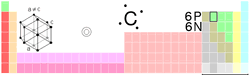 Carbon is a nonmetal element, symbol C, atomic
number 6. Carbon is a nonmetal element, symbol C, atomic
number 6.
Carbon is one of the elements that people have known about for the longest.
Carbon has several allotropes, or forms, including the naturally occuring graphite (used in pencil leads mixed with clay), diamond and amorphous carbon, which is carbon without a crystalline structure - examples are coal and soot.
The properties of graphite and diamond are very different from each other.
| Property |
Graphite |
Diamond |
| Appearance |
Black silver. |
Transparent. |
| Hardness |
Very soft, 1-2 on the Mohs scale. |
Very hard, 10 on the Mohs scale; it is the hardest naturally occuring material. |
| Smoothness |
Very slippery, displays superlubricity. |
The ultimate abrasive. |
| Electrical conductivity |
Electrically conductive. |
Excellent electrical insulator. |
| Thermal conductivity |
Extremely thermal conductivity parallel to graphite layers, similar to or exceeding that of diamond.
Relatively low thermal conductivity perpendicular to the layers. |
Extremely high thermal conductivity, several times that of copper. |
| Chemical reactivity |
Very reative.
Corrosive to aluminium in the presence of water. |
Very stable. |
| Surface properties |
|
Cannot be wet by water, can be by oil. |
Dry Ice
When most compounds transition from a solid to a gas they
first melt to become a liquid, then evaporate to became a gas. ome compounds
go directly from a soild to a gas, in a process called sublimation. See
the States of Matter page for more information.
Solid carbon dioxide is called dry ice because it sublimates. It doesn't
have a liquid form at all at atmospheric pressure, but at 5.1 atm (atmospheres)
it does form a liquid, and stays a liquid for a wider temperature range
the higher the pressure.
Dry ice sublimates at -78°C, so it can be used to cool methylated
spirits down to that temperature. The meths is then a supercooled liquid, and can be used to snap freeze small thin objects like flowers.
|



