Chapter 16: Chemistry in
Today's World
top ten | distillation | nobel gases
Top ten chemists
The top ten chemists of all time, in date order.
| Chemist |
Lived |
Accomplishments |
| Robert Boyle |
1627-1691 |
- Helped start the Royal Society.
- Showed air followed laws.
- Discovered phosphorus.
- Christian.
|
| Henry Cavendish |
1731-1810 |
|
| Antoine Laurent Lavoisier |
1743-1794 |
- Made measurement an essential part of chemistry.
- Stated the law of conservation of matter.
|
| John Dalton |
1766-1844 |
- Atomic theory.
- Showed methane is made of carbon and hydrogen.
- Quaker.
|
| Humphry Davy |
1778-1829 |
- Used electricity to refine elements.
- Discovered potassium, sodium, barium, strontium, calcium, magnesium.
- "Discovered" Michael Faraday.
|
| Jöns Jakob Berzelius |
1779-1848 |
- Analysed 2,000 compounds.
- Established the law of definite proportions*.
- Discovered cerium, selenium, thorium.
|
| Michael Faraday |
1791-1867 |
- Explained the operation of a battery.
- Discovered benzene.
- Christian - belief in a triune God led him to discover how electricity,
magnetism and light are related (and thus was an even greater
physicist than he was a chemist).
- Believed the Bible contains perfect truth.
|
| Louis Pasteur |
1822-1895 |
- Discovered optical isomers.
- Explaned fermentation.
- Christian.
|
| Dmitri Ivanovich Mendaleev |
1834-1907 |
|
| William Ramsey |
1852-1916 |
- Discovered whole family of noble gases and isolated argon, krypton,
neon, xenon.
- 1904 Nobel Prize in chemistry.
- Christian.
|
* The law of definite proportions says that a particular compound
will always be made of the same amount of each substance. For example,
water will always be made of two hydrogen atoms and one oxygen atom -
H2O. Aluminium oxide (alumina) will always be made of two aluminium
atoms and three oxygen atoms - Al2O3. Because of
this, knowing the molecular mass of the component atoms, we can calculate
how much aluminium is in a certain amount of alumina.
Also available are the religious
beliefs of some important physicists.
Distillation
Distillation is a process used to separate liquids (with different
boiling points) or to purify a liquid, by boiling it then condensing it
back into its liquid form. Impurities are left behind when the liquid
is boiled. For example, muddy water or sea water can be distilled into
pure water. Distilling sea water is a process that can be used to get
drinking water from sea water.
Distillation was invented by Greek chemists in the first century AD.
Fractional distillation is used to separate a mixture of liquids
when they have boiling points which are close together, normally within
25 °C. Cryongenic (very cold) fractional distillation is used when
the boiling points are well below room temperature, such as with liquid
air. Their vapours rise through a fractionating column and condense at
different levels - the lightest ones - those with the lowest boiling point
- at the highest levels. Argon is relatively inexpensive because it can
be produced easily with this method.
| Atmospheric Gas |
Proportion of Air (by volume) |
Boiling Point |
| Neon (Ne) |
1 part in 65,000 |
-246.08 °C |
| Nitrogen (N2) |
78.1% |
-195.79 °C |
| Argon (Ar) |
0.934% |
-185.85 °C |
| Oxygen (O2) |
20.95% |
-182.95 °C |
| Krypton (Kr) |
1 ppm |
-153.22 °C |
| Xenon (Xe) |
1 part in 20 million |
-108.12 °C |
Carbon dioxide (0.038% of air, boiling point -78 °C) may be obtained
from air distillation, however this yields only very small quantities
of CO2.
Advanced - nobel gases
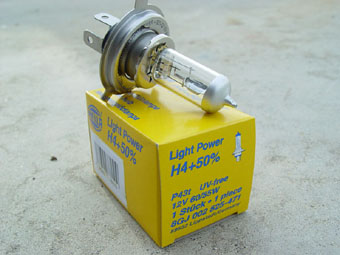 Why
are krypton and xenon used in some lightbulbs when argon is so much
more common, and therefore so much cheaper? It has to do with conducting
heat from the filament. The less heat conducted from the filament,
the hotter it is, and the more efficient it is. For low power bulbs
a vacuum works OK, but it turns out that for high power bulbs, using
an inert gas is better than using a vacuum, and some gases work
better than others. From the Great
Internet Light Bulb Book: Why
are krypton and xenon used in some lightbulbs when argon is so much
more common, and therefore so much cheaper? It has to do with conducting
heat from the filament. The less heat conducted from the filament,
the hotter it is, and the more efficient it is. For low power bulbs
a vacuum works OK, but it turns out that for high power bulbs, using
an inert gas is better than using a vacuum, and some gases work
better than others. From the Great
Internet Light Bulb Book:
Sometimes, premium fill gases such as krypton or xenon are
used. These gases have larger atoms that are better at bouncing
evaporated tungsten atoms back to the filament. These gases also
conduct heat less than argon. Of these two gases, xenon is better,
but more expensive. Either of these gases will significantly improve
the life of the bulb, or result in some improvement in efficiency,
or both. Often, the cost of these gases makes it uneconomical
to use them.
This all means there's no point in using neon, since argon does
a better job and is cheaper. |
Ethanol has a lower boiling point than water. Ethanol boils at 78.5 °C
while water boils at 100 °C. However, a mixture of 95% ethanol and
5% water boils at 78.2 °C. This mixture with a lower boiling point
than either component liquid, is called an azeotrope. For this reason,
ethanol cannot be completely purified by direct fractional distillation
of ethanol-water mixtures.
|



