Chapter 2: The Money Metals
same group | gold | silver | copper | mercury
Same group, similar properties
Gold, silver and copper are known as the coinage metals or money metals.
They are all from group 11 of the periodic table. They are all relatively
inert, corrosion-resistant metals which have been used for minting coins,
hence their name.
All three are quite soft, when used as coins are often alloyed with other
metals to make them more durable. They are all very malleable and ductile,
with gold being the most malleable and ductile metal. A single gram of
gold can be beaten out to a sheet with an area of 1 square metre, and
can be beaten so thin it's translucent. The transmitted light appears
greenish blue, because gold strongly reflects yellow and red.
They are all excellent conductors of electricity. The most conductive
of all metals are silver, copper and gold in that order. Silver is also
the second most thermally conductive metal (it's outdone by the non-metal
carbon, as diamond), followed by copper. All can be easily polished, and
silver is the most light reflecting element. Gold is a good reflector
of infrared and visible light. Copper, gold and caesium (a very reactive metal from group 1) are the only coloured metals.
Gold
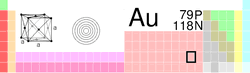 Gold is a metal element, symbol Au (from Latin "aurum" ), atomic
number 79. Gold is a metal element, symbol Au (from Latin "aurum" ), atomic
number 79.
It is a unique yellow colour and easily polished to a high shine. It
has been highly prized for thousands of years.
The purity of gold is measured in carats. Pure gold (99.99%) is 24 carat,
with less pure varieties normally having copper mixed in. For example,
18 carat gold is (normally) 75% gold with 25% copper. Sometimes silver
is used instead of copper, depending on the colour wanted.
Gold is found naturally as nuggets (small lumps) or fine specks, often
in quartz. Ore is most commonly gold sulphides in igneous (volcanic) rocks.
Seawater has lots of gold, but at a very low concentration (1-2 parts
per billion), and no one has figured out how to economically get gold
out of seawater.
| Gold attribute |
Makes it useful for |
Very dense:
19.3 x density of water
1.7 x density of lead
11.1 x density of magnesium |
Gold would make great bullets if it weren't so expensive, but it
would make really bad wheel rims for cars (which should ideally be
as light as possible). |
| Soft |
About the same hardness as a fingernail, 2.5 on the Mohs scale of
mineral hardness, which means by itself it's too soft for ordinary
use. |
| Ductile |
Very fine wires can be made from it - useful for electronics
such as integrated circuits. A semiconductor manufacturer on the
web sells gold wire as fine as 0.013 mm (0.0005"). The diameter
of human hair ranges from 0.02 mm to 0.18 mm.
From the web: The most important use of gold [in computers]
is as a fine wire that connects circuits to the semiconductors,
or the "brains" of the computer. This "bonding wire"
is specially refined (up to "five nines" or 99.999% pure
gold) and has an average diameter of one hundredth of a millimeter
- smaller than the diameter of a human hair. |
| Malleable |
A single gram (a lump about 10mm x 10mm x 0.5mm thick) can be beaten
out to a square metre in size. (In comparison, a NZ$2 coin weighs
10 grams.) |
| Inert (does not tarnish or corrode in air) |
Used for decoration, it will always look golden. Gold wires will
not corrode (in a normal environment). |
| Conducts electricity very well |
Ideal for high quality electrical connections like integrated circuits
and plugs and sockets for audio cables. |
| Good reflector of infrared and visible light. |
Protective coatings on many artificial satellites and on astronauts'
helmets to prevent blindness from the sun. |
| Good reflector of electrons. |
Gold is used as a coating enabling biological material to be viewed
under a scanning electron microscope. |
Colouring glass. Metallic gold, in very small concentrations (around
0.001%), produces a rich ruby-coloured glass ("ruby gold"),
while lower concentrations produces a less intense red, often marketed
as "cranberry". The color is caused by the size and dispersion
of gold particles. Ruby gold glass is usually made of lead glass with added tin.
Trivia. 75% of all gold ever produced has been extracted since
1910. It has been estimated that all the gold in the world that has ever
been refined would form a single cube 20 m (66 ft) a side.
Silver
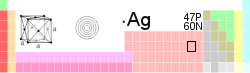 Silver is a metal element, symbol Ag (from Latin "argent" ), atomic
number 47. Silver is a metal element, symbol Ag (from Latin "argent" ), atomic
number 47.
Sterling silver is an alloy of silver containing (by definition) 92.5%
pure silver and 7.5% other metals, usually copper, since pure silver is
too soft to be usable for much. (The textbook mentions 11/12 which is actually wrong - by definition and by proportion, since 11/12 is only 91.67%.)
Fine silver is 99.9% silver or better.
Silver is most often found as ore in association with ores of copper,
gold, lead, etc. Mexico is the world's largest silver producer.
| Silver attribute |
Makes is useful for |
| The highest electrical and thermal conductivity of any metal. |
High quality electrical connections, printed circuit boards (PDBs),
etc, but because it tarnishes is not used for electrical connectors
like gold is, and its greater cost than copper has kept it from being used for common wire or PCBs. |
| Highest optical reflectivity of any element. |
Makes it ideal for high quality mirrors, including those in telescopes.
(Normal mirrors use aluminium.) |
| Very malleable, only slightly harder than gold. |
Usually needs to be alloyed with other materials (often copper)
to make it hard enough for everyday use. |
| Silver halides are light sensitive. |
Photography. |
Tarnish. As the purity of silver increases, the problem of corrosion
or tarnishing lessens. Chemically, silver is not very active - it does
not react with oxygen or water at ordinary temperatures, so does not easily
form a silver oxide. However, the other metal in the alloy, usually copper,
may react with oxygen in the air. The black tarnish on silver is silver
sulphide (Ag2S) and is best removed with products that remove
the sulphur from the silver rather than scouring it away, which will damage
the item. Something from my mother's medical audio tapes – one German
man completely tarnished a silver coin in just 24 hours when it was in
his back pocket.
Sodium chloride (NaCl) or common table salt is known to corrode silver-copper
alloy, typically seen in silver salt shakers where corrosion appears around
the holes in the top.
Glass cement. Silver chloride can be made transparent and is used
as a cement for glass.
Argyria. Argyria is a skin discolouration that results from ingesting (eg, eating,
drinking) too much silver, such as from drinking a lot of colloidal
silver – water with ultra-fine silver particles in suspension (a
product occasionally advertised on Radio Rhema). You cannot get
argyria from using silver cutlery.
Stan
Jones (a US politician, pictured at right) got argyria from
drinking homemade colloidal silver. He still drinks it because he
thinks it keeps him healthy. |
|
 |
Rosemary
Jacobs is another person who got argyria, pictured here before she
had a dermal abrasion (where the top layer of her skin was sanded off).
She got it from silver-containing nose drops (before the side effects
of silver solution were well known). Nose drops do not contain silver
these days. I've emailed her several times and she is still passionate
about warning people of the dangers of drinking colloidal silver.
 
Copper
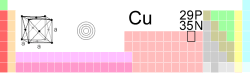 Copper is a metal element, symbol Cu (from Latin "cuprum" ), atomic
number 29. Copper is a metal element, symbol Cu (from Latin "cuprum" ), atomic
number 29.
Copper is orange-red coloured but develops a surface patina of copper
carbonate (CuCO3) and sometimes a few other compounds - a light
green covering that protects the copper from further deterioration. This
is why the Stature of Liberty is the colour it is (it has over 81 tonnes
of copper).
Most copper ore is mined or extracted as copper sulphides from large open
pit mines in porphyry copper deposits that contain 0.4 to 1.0 percent
copper. Examples include: Chuquicamata in Chile and El Chino Mine in New
Mexico.
| Silver attribute |
Makes it useful for |
| Ductile |
Wire. |
| Malleable |
Plumbing, guttering, roofing, sculture (Statue of Liberty). |
| High electric conductivity (second only to silver) |
Wire, printed circuit boards. |
Alloys and coins. Copper is a component of various alloys, including
brass (a copper/zinc alloy), and bronze (a copper/tin alloy). Our silver-coloured
coins are made of an alloy of 75% copper and 25% nickel ("cupro-nickel").
Our gold-coloured $1 and $2 coins are 92% copper, 6% aluminium, 2% nickel
("aluminium bronze"). When our 1 and 2 cent coins were dropped
in 1990 there was at least 1.7 cents of copper in a one cent coin.
Since 1992 UK
pennies have been copper plated steel (and are magnetic).
From 2000 on, Canadian
pennies have been 94% steel, 1.5% nickel, 4.5% copper plated zinc.
From 1942 to 1996 they were 98% copper.
American
pennies from before 1982 were 95% copper, 5% zinc, but after that,
due to the cost of copper, they are copper-coated zinc - only 2.5% copper,
97.5% zinc. (A pre-1982 US cent now contains about 2.2 cents of copper.)
A fun thing to do is file some small nicks in the copper coating of a
post-1982 US cent, revealing the zinc, then drop it into hydrochloric
acid, which eats the zinc away from the middle. After a day or so you're
left with a hollow copper coin. Wash well then rinse using ethanol (which
dries more easily than water).
Sidetrack
Edmond Knowles, of Flomaton, Alabama, USA, hoarded pennies for
nearly four decades as a hobby. He ended up with more than 1.3 million
of them - 4.5 tons - in several drums in his garage. His bank refused
to take them all at once, but in 2005 he finally found a coin-counting
company, Coinstar, that wanted the publicity.
In the biggest known penny cash-in ever, they sent an armoured
truck, loaded his pennies, and then watched helplessly as it sank
into the mud in his yard. They needed a tow truck to redeem it.
"I still got a few ruts in the yard," says Knowles.
His years of collecting brought him about $1 a day - $13,084.59
in all. |
Roofing. Some cities have many roofs made of copper, which develop
a light green coloured patina after a few years.
Biostatic. Bacteria will not grow on a copper surface, so some
hospitals use copper door handles. Copper pipes reduce the likelihood
of Legionnaire's Disease in air conditioning systems.
Gardening. Copper-based sprays are used in gardening.
Pyrotechnics. Copper compounds such as copper sulphate are used
to give a blue colour in fireworks. Hydrated copper sulphate (CuSo4.5H2O)
is bright blue and is poisonous but can be used to grow attractive large
crystals or to copper plate items. The anhydrous version (CuSo4)
is pale green and can be used to test for water, as it turns blue when
it absorbs water molecules.
Schizophrenia. Studies have found that people with mental illnesses
such as schizophrenia had heightened levels of copper in their systems.
However it is unknown at this stage whether the copper contributes to
the mental illness, whether the body attempts to store more copper in
response to the illness, or whether the high levels of copper are the
result of the mental illness.
Oxygen transport. Most molluscs use the copper-containing pigment
hemocyanin rather than iron-containing hemoglobin for oxygen transport,
so their blood is blue when oxygenated rather than red.
Mercury
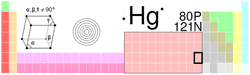 Mercury is a liquid metal element, symbol Hg (from Latinized Greek "hydrargyrum"),
atomic number 80 (one more than gold). Mercury is a liquid metal element, symbol Hg (from Latinized Greek "hydrargyrum"),
atomic number 80 (one more than gold).
Also called quicksilver, mercury is the only metal to be a liquid at room temperature. (Gallium melts at
the slightly warmer 29.8 °C.)
Mercury is denser than lead, so a bar of lead will float in a pool of
mercury.
Toxic. Mercury is poisonous, as is mercury vapour. Do not touch
liquid mercury and have good ventilation where mercury is open to the
air (although don't have a breeze blowing across the mercury, as that
will encourage more vapour).
Tooth fillings. An amalgam is made from 50% mercury and 50% powdered
mixture of other materials like silver, tin, copper, etc. After combining
together the amalgam is still soft for a little while. It hardens after
put into the tooth. Using mercury in teeth is controversial: The majority of dentists claim that dental amalgams are not only safe
for use but desirable, since they are cheap, easy to use, fairly durable
and strong, can be quickly inserted into the oral cavity and that any
release of mercury vapor is too negligible to be an issue. Opponents,
however, argue that repetitive exposure to a very small amount of mercury
can be cumulative, so amalgams can cause many diseases, and that there
are many alternative filling materials which can easily be used instead
of amalgam.
Thermometers. Mercury is well known for its use in thermometers,
but because of the toxicity of mercury, alcohol or digital thermometers
are preferred these days.
Lighting. Mercury vapour lamps are quite high efficiency lights
that give good colour rendition (unlike low pressure sodium vapour lamps
which are very orange but very high efficiency).
Tilt switches. Because mercury conducts electricity, a small drop
of mercury can be used to close the contacts on a switch when it is oriented
correctly. When the switch is tilted the mercury moves and breaks the
connection.
|



