Chapter 3: The Search for
Gold
sulphur | carbon
| phosphorus | smells
Sulphur
 Sulphur
is a non-metal element, symbol S, atomic number 16. Sulphur
is a non-metal element, symbol S, atomic number 16.
While normally spelled sulphur in English-speaking countries, sulfur is the spelling used in the USA and the one officially
adopted by the International Union of Pure and Applied Chemistry (IUPAC).
Sulphur is a bright yellow colour and is insoluble in water.
Burns with a blue flame producing sulphur dioxide (SO2),
an unpleasant smelling gas that irritates the lungs. Sulphur dioxide is
used to preserve apricots and (quite separately) make sulphuric acid. Sulphur
dioxide in the air is a bad thing because it makes sulphuric acid naturally
and causes acid rain.
Hydrogen sulphide (H2S) is the gas
that smells like rotting eggs, Rotorua, etc. The toxicity of H2S
is comparable with that of hydrogen cyanide. Most people can smell it
at only about 5 parts per billion (or 0.0000005%), which is 5 cubic millimeters
of H2S diluted in a cubic meter of air. In other words, a really
small amount in a large amount of air. Concentrations over 0.1% (1 part
per thousand) cause immediate collapse with loss of breathing, even after
inhalation of a single breath.
Breathing hydrogen sulphide paralyzes the olfactory nerve making it impossible
to smell the gas, which is why Rotorua doesn't smell as bad after you've
been there a few hours. This can be very dangerous because of the toxicity
of H2S, and because it's slightly heavier than air, and can
collect down wells, in underground toilets, sewers, etc.
Hydrogen sulphide tarnishes silver, producing black-coloured silver sulphide
(Ag2S). Hydrogen sulphide is highly flammable, forming an explosive
mixture with air over a wide range of concentrations (4.3-46%).
Vulcanised rubber is made from natural latex rubber mixed with
sulphur. It was discovered after Charles Goodyear when he had an accident
with his chemicals. He took ten years before he discovered it, and another
five years of improvement before he patented it. Sadly, it was easily
copied, and he spent large amounts of time and money trying to defend
his patents.
Black powder uses sulphur as a main ingredient. (The term gunpowder
includes black powder and smokeless powder, which covers things like cordite.)
Black powder has been around since at least AD850. The current standard
for black powder manufactured by pyrotechnicians today contains 10% sulphur
by mass.
Zinc sulphide (ZnS), with addition of few ppm of copper an an activator,
provides long glow time and the familiar glow-in-the-dark greenish colour.
Other activators are silver, giving bright blue light, and manganese,
which gives a yellow colour.
Carbon
 Carbon
is a non-metal element, symbol C, atomic number 6. Carbon
is a non-metal element, symbol C, atomic number 6.
Carbon has two common forms – graphite and diamond. Graphite has a Mohs
hardness of 1-2, while diamond is 10 on the Mohs scale. Graphite is
the most stable form of carbon, and diamonds are extremely slowly turning
back into graphite.
| Graphite |
Diamond |
| Opaque (black). |
Transparent (over a larger range of wavelengths – from the ultraviolet
into the far infrared – than is any other solid or liquid substance,
nothing else even comes close). |
Very soft.
Lubricant. |
Very hard (almost four times harder than next hardest mineral
in the Mohs scale and about 1,500 times harder than graphite).
Abrasive. |
| Electrical conductor. |
Electrical insulator (although some blue diamonds – which contain
boron atoms in place of some of the carbon atoms – are natural semiconductors). |
| Can be a very good thermal insulator in intumescent materials. |
Thermal conductor (synthetic diamond can be six times better than
second placed silver). |
| Hexagonal structure – perfect cleavage in one direction. |
Pyramidial structure – perfect cleavage in four directions (makes
it brittle). |
Graphite is used in pencil
leads, mixed with different amounts of clay for different hardnesses.
In order, the leads are (from hardest to softest) 9H through to 2H, H,
F, HB, B, 2B through to 9B. (H = hard or hardness, B = black or blackness,
F = fine point.) The American #2 pencil is the same as HB. Today, pencils
are made industrially by mixing finely ground graphite and clay powders,
adding water, forming long spaghetti-like strings, and firing them in
a kiln. The resulting strings are dipped in oil or molten wax which seeps
into the tiny holes of the material, resulting in smoother writing.
Diamond has four directions of cleavage, meaning that if it receives
a sharp blow in one of these directions it will cleave, or split. A skilled
diamond setter and/or jeweler will prevent any of these directions from
being in a position to be struck while mounted in a jewelry piece.
Diamond's high thermal conductivity is used in semiconductor manufacture
to prevent silicon overheating.
14C found in diamonds.
14C is a radioactive isotope of carbon with a half life
of ~5,700 years. After each half life, the amount of 14C
halves, eventually getting too low to detect. Thus, anything containing
14C cannot be more than a few tens of thousands of years
old. This report from Creation
on the Web (first published: Creation 26(2):42–44, March 2004):
Dr Baumgardner [of Los Alamos National Laboratory in the USA]
sent five diamonds to be analyzed for 14C. It was the
first time this had been attempted, and the answer came back positive
— 14C was present. The diamonds, formed deep
inside the earth, are assumed by evolutionists to be over a billion
years old. Nevertheless they contained radioactive carbon, even
though, if the billion-year age were correct, they ‘shouldn’t
have’.
This is exceptionally striking evidence, because a diamond
has remarkably strong lattice bonds (that’s why it’s
the hardest substance known), so subsequent atmospheric or biological
contamination should not find its way into the interior.
The diamonds’ carbon-dated ‘age’ of about
58,000 years is thus an upper limit for the age of the whole earth.
Again, this is entirely consistent with helium diffusion results
reported above, which indicate the upper limit is in fact substantially
less.
|
Carbon dioxide (CO2) is formed from carbon combining
with oxygen when it burns or in respiration. Carbon dioxide is essential
for plants. Carbon can bond with itself and many other elements, with
nearly ten million carbon compounds known. Carbon occurs in all living
things. More on carbon dioxide
on the chapter 4 page.
Rubber tyres have carbon black (like soot but with much higher
surface area to volume ratio) added to improve strength and reduce perishing
due to UV light. It also helps conduct heat away from the tread, thereby
reducing thermal damage and increasing life.
Black powder uses carbon as a main ingredient, in the form of
charcoal. The current standard for black powder manufactured by pyrotechnicians
today contains 15% softwood charcoal.
Phosphorus
 Phosphorus
is a non-metal element, symbol P, atomic number 15. Phosphorus
is a non-metal element, symbol P, atomic number 15.
Phosphorus is found in all living cells and is used in matches, explosives,
fertilisers, toothpaste and detergents. As one example, Ca(H2PO4)2•H2O
is used in baking powder.
The two most common forms are white and red.
 Matches
originally used white phosphorus, which was quite dangerous as white
phosphorus spontaneously ignites at 30°C. Matches
originally used white phosphorus, which was quite dangerous as white
phosphorus spontaneously ignites at 30°C.
Safety
matches' safety is due to the replacement of white phosphorus
with the more stable red phosphorus, and the separation of the combustible
ingredients between the match head and a special striking surface.
Wikipedia:
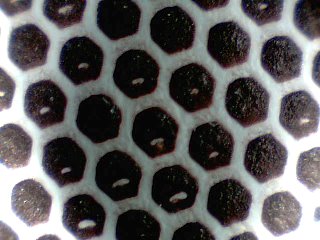
The striking surface [pictured at left] is composed of
typically 25% powdered glass, 50% red phosphorus, 5% neutralizer,
4% carbon black and 16% binder; and the match head is typically
composed of 45-55% potassium chlorate, with a little sulphur and
starch, a neutralizer (ZnO or CaCO3), 20-40% of siliceous
filler, diatomite and glue.
Another source says the match head is composed of antimony(III)
sulphide and potassium chlorate. The act of striking converts some
of the red phosphorus to white by friction heat. The small amount
of white phosphorus then ignites, and this starts the combustion
of the match head.
Wikipedia: On the television program MythBusters, special-effects
experts Jamie Hyneman and Adam Savage proved that a satchel of sixty
thousand (60,000) match-heads could send a 6-pound (3 kg) bowling
ball flying 1,500 feet (500 m). |
The word phosphorescence was inspired by the way phosphorus glows
when exposed to the right amount of oxygen - a reaction which is actually
called chemoluminescence. Phosphorescence is a process in which light
energy stored in a substance is released very slowly and continuously
in the form of glowing light. (The phosphorus glow, by the way, was known
since 1669 but only explained in 1974.)
Matches, smells, and sulphur
Striking a match in a toilet room to get rid of the smell does work,
but only partly. The burning chemicals cover the smell of methanethiol
(aka methyl mercaptan, CH3SH), the chemical that smells like
rotten cabbage. The smell of hydrogen sulphide (rotten eggs, H2S)
is not affected.
Also see the section on the chapter 4 page about how some
air fresheners use ozone to oxidise these smelly substances.
|



