Chapter 14: Silicon and its
Compounds
silicon | crust
| precious stones | electronics
Silicon
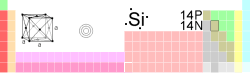 Silicon
is a non metal element, symbol Si, atomic number 14. Silicon
is a non metal element, symbol Si, atomic number 14.
It is the second most common element in Earth's crust (after oxygen)
and is 25.7% of the crust by mass. It has many uses, eg, rock and sand,
quartz and glass, semiconductors like transistors and integrated circuits,
and silicones, used for lubricants, hydraulic fluids, sealants and even
thermal heat paste.
Elemental silicon is crystaline and (as a powder) is dark grey with bluish
tinge. It has a metallic sheen that increases with the crystal size. It
is not as reactive as carbon, which
is just above silicon in the periodic table. Like carbon, silicon tries
to form four bonds. Silicon is prepared by reacting silica
with carbon in electric arc furnaces at temperatures over 1,900 °C:
SiO2 + C → Si + CO2
Silicon is essential in biology, although only trace amounts are required
by animals. (This means that babies don't have to eat sand at the beach,
although they seem to anyway.) Plant metabolism depends on silicon.
Wikipedia: Silly Putty was originally made by adding boric acid to
silicone oil. Now name-brand Silly Putty also contains significant amounts
of elemental silicon (silicon binds to the silicone and allows the material
to bounce 20% higher).
Earth's crust
From Wikipedia, Earth's
crust: In all Earth's crust occupies less than 1% of Earth's volume.
... The common rock constituents of the Earth's crust are nearly all oxides.
Chlorine, sulphur and fluorine are the only important exceptions to this
and their total amount in any rock is usually much less than 1%. F. W.
Clarke has calculated that a little more than 47% of the Earth's crust
consists of oxygen. It occurs principally in combination as oxides, of
which the chief are silicon, aluminium, iron, calcium, magnesium, potassium
and sodium oxides. Silica is a major constituent of the crust occurring
as the silicate minerals, which are the most common minerals of igneous
and metamorphic rocks. From a computation based on 1672 analyses of all
kinds of rocks Clarke arrived at the following as the average percentage
composition by mass:
| Names |
Oxide |
Percent by mass |
| Silica, silicon dioxide |
SiO2 |
59.71 |
| Alumina, aluminium oxide |
Al2O3 |
15.41 |
| Lime, calcium oxide |
CaO |
4.90 |
| Magnesia, magnesium oxide |
MgO |
4.36 |
| Sodium oxide |
Na2O |
3.55 |
| Ferrous oxide |
FeO |
3.52 |
| Potassium oxide |
K2O |
2.80 |
| Hematite, ferric oxide, rust, rouge |
Fe2O3 |
2.63 |
| Water |
H2O |
1.52 |
| Titanium dioxide, titania |
TiO2 |
0.60 |
| Phosphorus pentoxide |
P2O5 |
0.22 |
| Total |
99.22 |
All the other constituents occur only in very small quantities, and
total less than 1%.
Silicon dioxide (silica) is the most common component of beach sand.
Precious Stones
Many precious stones have silicon in them. A few examples:
Amethyst
is silica (quartz, SiO2) with the purple colouring from a complex
interaction of iron and aluminium impurities.
Beryl (Be3Al2(SiO3)O6) is
colorless in its pure mineral form. Adding chromium (and sometimes vanadium)
impurities gives emerald.
Manganese impurities gives pink (Mn2+) morganite
or red (Mn3+) red
beryl. With iron it becomes pale blue (Fe2+) aquamarine,
dark blue (Fe2+ and Fe3+) maxixe,
or golden yellow (Fe3+) aquamarine
chrysolite. The largest known crystal of any mineral in the world
is a crystal of beryl from Madagascar, 18 metres long and 3.5 metres in
diameter.
Chrysoberyl
(BeAl2O4) is not a silicate gem.
Topaz
(Al2SiO4(F,OH)2) is colorless
and transparent but is usually tinted by impurities; typical topaz is
wine, yellow, pale gray or reddish-orange, blue brown. It can also be
made white, pale green, blue, gold, pink (rare), reddish-yellow or opaque
to transparent/translucent. Naturally occurring Blue Topaz is quite rare.
Typically, colorless, gray or pale yellow and blue material is heat treated
and irradiated to produce a more desired darker blue.
Garnet
is a class of gem with a general formula X3Y2(SiO4)3.
The X site is usually occupied by divalent cations (Ca2+, Mg2+,
Fe2+) and the Y site by trivalent cations (Al3+,
Fe3+, Cr3+) in an octahedral/tetrahedral framework
with [SiO4]4- occupying the tetrahedra. One of the
most sought after varieties of gem garnet is the fine green grossular
garnet from Kenya and Tanzania called tsavorite.
This garnet was discovered in the 1960s in the Tsavo area of Kenya, from
which the gem takes its name. (The movie The Ghost and the Darkness
was based on real events in Tsavo.)
Error in book: Opal is NOT the most valuable silicate gem.
That is simply stupid. Top quality emeralds are even more expensive than
diamonds, and I don't think anyone believes opals are more valuable than
diamonds. (The most valuable non-silicate gem is possibly cat's eye alexandrite,
a form of chrysoberyl that changes colour under different sorts of lighting
and has a cat's eye inclusion.) The most valuable form of quartz is citrine
according to this
page, but this
page says amethyst is.
Electronics
On the periodic table silicon is positioned between the metals and non-metals.
It has chemical and electrical properties between the two. It is a semi-conductor,
and is by far the most common semi-conductor used for making transistors
and integrated circuits. Silicon retains its semiconducting properties
at higher temperatures than germanium,
another semiconductor and the element just underneath silicon in the periodic
table.
An LED is a semi-conductor that uses other semi-conducting elements such
as gallium
arsenide. To run an LED at a steady brightness (especially from batteries)
a constant current is wanted, which can be provided using a circuit with
a couple of silicon-based transistors and a couple of resistors.
One of the transistors must be able to handle a lot of power, which means
a lot of excess heat. To get rid of that heat a heatsink is used, and
firmly attached (eg, bolted) to the transistor with silicone thermal
compound.
For more information on electronics and electronic components see the
Electronics section.
|



